OSHA Compliance Checklist for Small Manufacturers

- Published On:
- OSHA Management
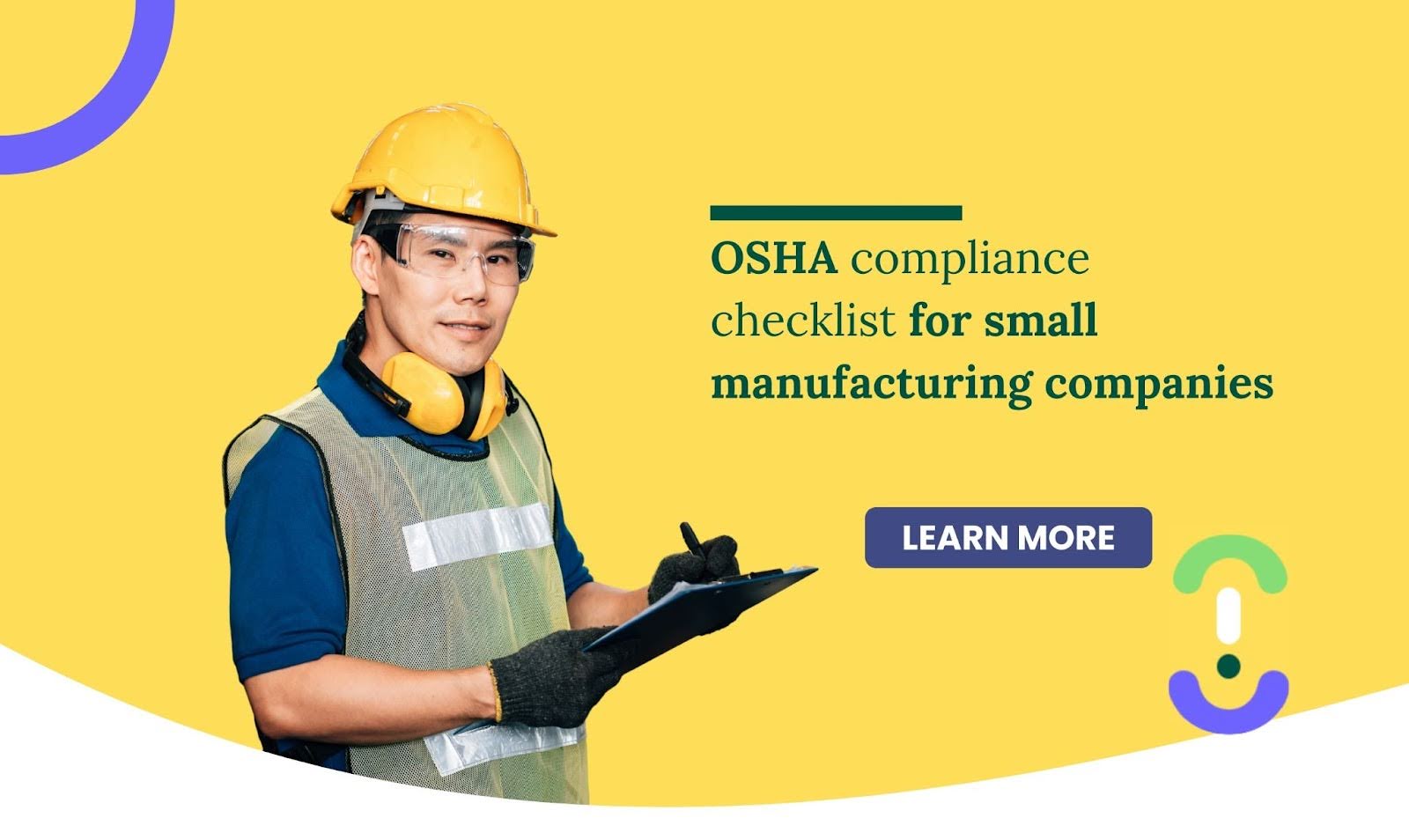
Small manufacturing companies must meet the same OSHA safety standards as larger corporations, yet many lack dedicated safety staff. Non-compliance costs thousands in fines and worker compensation claims. This checklist breaks OSHA requirements into specific, actionable steps small manufacturers can implement within four months to reduce workplace injuries, avoid violations, and prepare for regulatory inspections.
OSHA (Occupational Safety and Health Administration) establishes minimum workplace safety standards that all employers must follow. The agency enforces compliance through inspections, incident investigations, and penalties for violations. Manufacturing facilities face heightened scrutiny due to machinery hazards, chemical exposure, and equipment risks.
Workplace injuries remain a significant challenge across American industries. OSHA’s data shows over 1.5 million work-related injuries and illnesses reported from more than 385,000 establishments. Manufacturing ranks among the highest-risk industries for workplace injuries. Healthcare leads all sectors with 308,000 injuries annually. Penalties for non-compliance are substantial. According to OSHA’s 2024 penalty schedule, serious and other-than-serious violations carry a maximum penalty of $16,131 per violation. Willful or repeated violations carry significantly higher penalties reaching $161,323 per violation. These figures demonstrate why OSHA enforcement and compliance are critical to protecting workers and maintaining safe operations.
How OSHA Operates:
- Sets and enforces safety standards applicable to your industry
- Conducts workplace inspections based on routine checks, complaints, or serious incidents
- Investigate worker injuries and illnesses to identify violations
- Issues citations and penalties for non-compliance
- Provides free consultation and training resources at OSHA.gov
Manufacturing’s Obligations:
Manufacturing employers must implement documented safety programs addressing machinery guards, chemical safety, electrical hazards, fall protection, personal protective equipment, employee training, and incident investigation. Compliance requirements are identical for small and large manufacturers.
Key Components of OSHA Compliance Checklist
Written Safety Program
Document your safety policy, assign safety responsibility, and create incident reporting procedures. Make the policy accessible to all employees and review it annually.
Hazard Identification
Walk through your facility and identify hazards, including machinery, chemicals, electrical equipment, falls, and noise. Rate each hazard by likelihood and severity. Use Hazard Management solutions to organize findings.
Personal Protective Equipment
Determine the required PPE for each job. Provide PPE at no cost to employees. Train workers on proper use, care, and maintenance. Use PPE Management solutions to track distribution and compliance.
Hazard Communication
Maintain Safety Data Sheets (SDS) for all hazardous chemicals. Label containers clearly. Train employees on chemical hazards and safe handling.
Machine Safety and Lockout/Tagout
Guard dangerous equipment with moving parts. Establish lockout/tagout procedures to de-energize equipment during maintenance. Implement Lockout/Tagout Management to standardize energy control procedures.
Employee Training
Conduct initial safety orientation and job-specific training. Require annual refresher training and maintain complete records. Use Training Management solutions for record keeping.
Use worker certification and training software to automate record-keeping.
Incident Documentation
Log all work-related injuries and illnesses. Investigate incidents within 24 hours to determine root causes. Track incidents using Incident Management systems rather than spreadsheets.
Regular Inspections
Conduct facility inspections monthly or quarterly. Document all findings and address problems promptly. Use Inspections Management to standardize your inspection process.
Strengthen Employee Retention and Morale
Companies known for workplace safety attract better job candidates. Employees value working for organizations that protect their well-being. Strong safety cultures improve retention, reduce costly turnover, and support workforce stability. Invest in workplace culture and engagement programs to reinforce safety values.
Importance of OSHA Compliance Checklist for Small Manufacturers
- Avoid Costly Penalties Violations cost $10,000 to $160,000 each. Systematic compliance prevents violations before inspections occur, saving substantial costs.
- Reduce Workplace Injuries: Safety programs reduce injuries and illnesses. Fewer injuries mean lower worker compensation premiums, reduced lost productivity, and improved morale.
- Meet Customer Requirements. Many manufacturers require supplier OSHA compliance as a contract condition. Demonstrating compliance wins contracts and strengthens relationships. Organizations pursuing both OSHA compliance and quality excellence often implement ISO 9001 quality management systems that integrate safety with quality.
- Improve Operational Efficiency:y Equipment maintenance prevents unexpected downtime. Standardized procedures reduce errors. Trained employees operate more safely and productively.
- Strengthen Reputation: Safety-focused companies attract better employees. Safety demonstrates professional operations and builds customer trust in bidding processes.
How to Implement an OSHA Compliance Checklist
- Month 1: Assessment and Planning.
Identify existing safety programs and gaps against OSHA standards. Assign a safety coordinator. Document your current state. - Month 2: Develop Program and Assess Hazards.
Write a safety policy. Document all hazards and rate them by likelihood and severity. Identify gaps using Hazard Management solutions.
Use job safety analysis software to systematically document hazards and required controls. - Month 3: Implement Controls
Establisha PPE program. Inspect machinery. Install guards. Create lockout/tagout procedures. - Month 4: Training and Systems
Develop safety training. Conduct employee training. Create a reporting process. Schedule inspections.
Ongoing Conduct monthly inspections. Investigate incidents within 24 hours. Update training annually. Use Audit & Risk Management for annual self-audits.
Benefits of OSHA Compliance Checklist
Lower Costs
Reduced injuries and lower worker compensation premiums. Equipment maintenance prevents costly downtime. Avoiding penalties saves substantial sums.
Reduced Injuries
Hazard identification prevents accidents. Training ensures workers understand risks. Regular inspections catch problems early. Systematic incident investigation prevents repeat incidents.
Better Morale
Employees value working for safety-focused companies. Higher morale improves retention and reduces turnover costs.
Competitive Advantage
Compliance documentation helps win contracts requiring OSHA compliance. Safety becomes a competitive differentiator.
Regulatory Readiness
Documented programs pass OSHA inspections more easily. Annual safety audits identify gaps before regulatory inspections.
Conclusion
OSHA compliance protects employees and strengthens business operations. Small manufacturers implementing systematic safety programs reduce injuries, avoid costly penalties, and improve their competitive position. Start with hazard assessment, document your safety program, train employees, and establish regular inspections. Knowella’s OSHA Management solution automates compliance tracking and eliminates spreadsheets, making implementation faster and more manageable.
Frequently Asked Questions
OSHA establishes minimum safety standards that employers must follow. OSHA inspects workplaces to ensure compliance and investigates serious incidents. Employers who violate OSHA standards face penalties and fines.
OSHA prioritizes inspections based on reported incidents, complaints, and industry-specific hazards. No set inspection frequency applies to all facilities. Maintaining a strong safety program reduces inspection likelihood.
Penalties depend on violation severity. Minor violations result in warnings or small fines. Serious violations cost $30,000 to $155,000. Willful violations reach $160,000 per violation.
Most small manufacturers implement core OSHA requirements within 4 months. Initial hazard assessment and written program require 4 to 6 weeks. Training and equipment safety controls require another 6 to 8 weeks.
The most frequent violations include inadequate machine guarding, missing or incomplete Safety Data Sheets, lack of training documentation, fall protection gaps on elevated work surfaces, and improper chemical container labeling. Addressing these specific areas prevents most violations.
Our tailored solutions address your industry’s distinct challenges, fostering growth and compliance.

Your Journey Starts with Knowella
Revolutionize your operations today with Knowella. Experience unparalleled efficiency, safety, and quality as you empower
your teams with the tools to excel. Elevate your business to new heights; explore Knowella now.

All articles Go back Safety culture doesn’t build itself through policies alone. Strong culture requires visible commitment, consistent messaging, and shared values that permeate daily
Small manufacturer OSHA compliance checklist covering safety requirements, hazard assessment, and audit preparation.

Real reasons companies adopt online collaboration tools. Learn how team productivity software improves efficiency, reduces costs, and strengthens operations.